
This issue overviews the U.S. Department of Health and Human Services and Department of Educations legal guidelines for inclusive early childhood education.
This issue overviews the U.S. Department of Health and Human Services and Department of Educations legal guidelines for inclusive early childhood education.
This issue overviews the U.S. Department of Health and Human Services and Department of Educations legal guidelines for inclusive early childhood education.

We present the concept of a STEM (Science, Technology, Engineering, Math) experience for all students including those with disabilities in the Early Childhood Education classroom and in all natural learning environments.

We present the concept of adapting art for all students including those with disabilities in the Early Childhood Education (ECE) classroom.

In this issue we present the strategy of Banking Time from the Pyramid Model's research. The goal is to foster a positive teacher-child relationship.

This month we explore the National Center for Pyramid Model Innovations (NCPMI) Pyramid Model, a framework of evidence-based practices for promoting young children's healthy social and emotional development.

This article continues to consider the CDC's developmental milestones (ages 3 -5), DAP, and the cultural contexts of children.

This month we share the Centers for Disease Control and Prevention (CDC) guide for Developmental Milestones which helps families and providers celebrate developmental progress, know what to expect next, and learn what to do if they have questions or concerns.

This issue considers how to use a strength-based observational framework from the Early Childhood Technical Assistance Center (ECTA) as an inclusive assessment strategy.

This article offers tangible examples of how teachers, paraprofessionals, and speech language pathologists can work together and offer inclusive curriculum.
This issue overviews the U.S. Department of Health and Human Services and Department of Educations legal guidelines for inclusive early childhood education.

This issue explores the importance and strategies of anti-bias education in preschool settings, aiming to empower all students' identities.

To start volume 2, this article focuses on preparing teachers' perspective and practice for a new school year's inclusive atmosphere.

Consider the Early Childhood Personnel Center's common core competencies across organizations and reflect on roles/responsibilities of various stakeholder positions.

Through Spence et al.'s (2021) article, this issue reflects on how various members of a child's Individualized Family Service Plan (IFSP) can collaborate to enhance inclusivity.
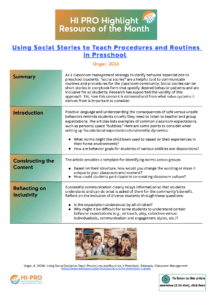
This issue focuses on classroom management strategies from the article, "Using Social Stories to Teach Procedures and Routines in Preschool" by Unger (2024).
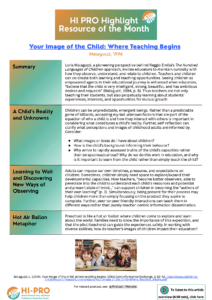
This issue features the work of Loris Malaguzzi, from the article “Your image of the child: Where teaching stressing the importance of maintaining curiosity in observing, understanding, and relating to children.
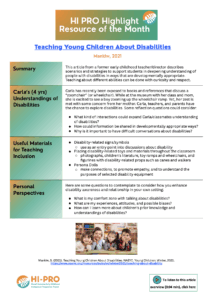
In this issue, we highlight the scenarios for early childhood educators from “Teaching Young Children About Disabilities” by Mankiw, 2021.
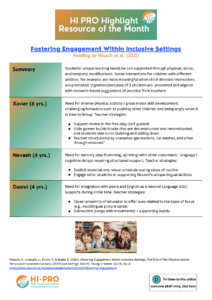
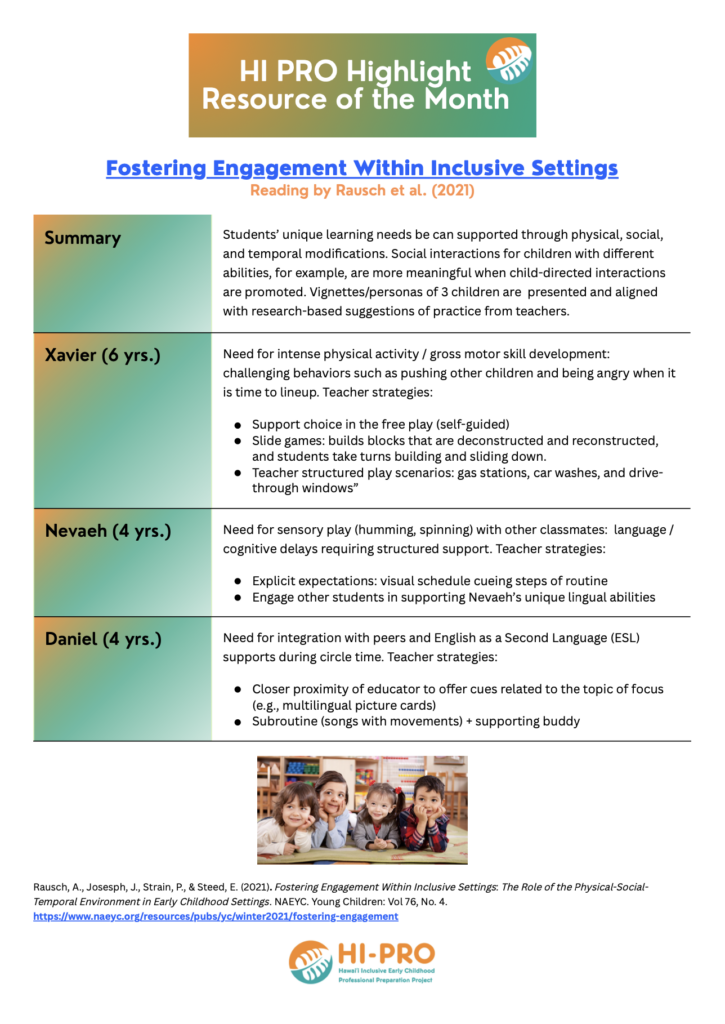
This issue features vignettes by Rausch, Strain, & Steed, E. (2021) from their article “Fostering Engagement Within Inclusive Settings: The Role of the Physical-SocialTemporal Environment in Early Childhood Settings”.